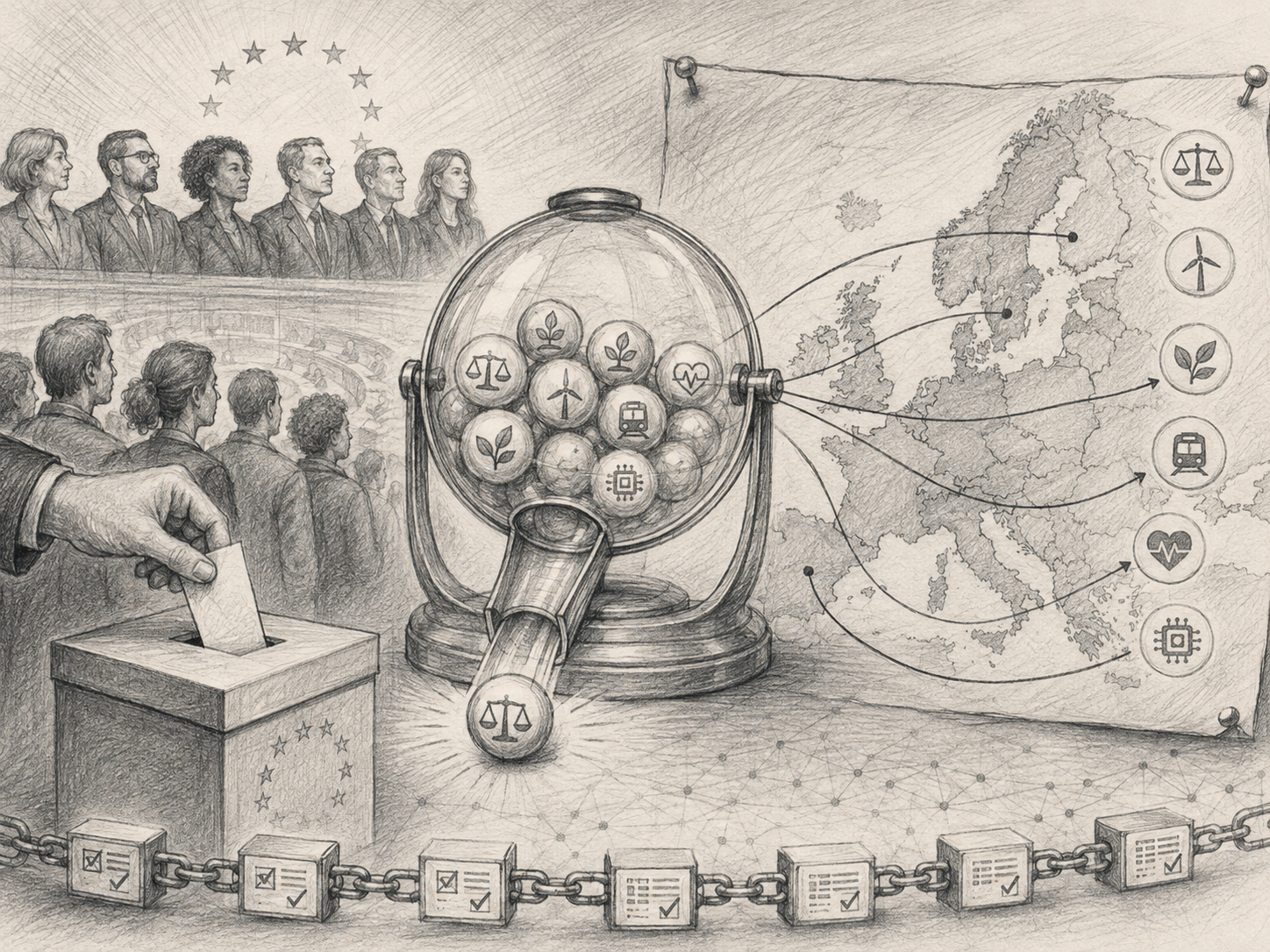

A German MEP wins a seat in the European Parliament. A few weeks later, a public draw gives her oversight of a transport programme in southern Italy. A Portuguese colleague gets an energy file concerning the Baltic states. Someone from Poland ends up chairing work on digital markets.
None of them knew the assignment while campaigning. Their parties didn't know either. That uncertainty is the point.
European politics contains plenty of elections, but voters have much less control over the distribution of responsibility after the votes are counted. Parties negotiate committee posts. Governments bargain over appointments. The President of the European Commission decides how the Commission is organised and allocates portfolios to individual Commissioners.
Somebody has to do this work, and political negotiation isn't inherently dirty. Still, predictability has side effects. If everyone knows where a piece of power will sit, everyone who wants access to that power knows where to build relationships.
I've been wondering whether a small part of that allocation should be taken out of political hands altogether.
The idea is simple enough to sound reckless: once representatives have been elected, a public lottery assigns some of their jobs. The draw is constrained by rules, auditable by anyone and repeated after a fixed term.
Call it the European Tombola.
What goes into the draw
Putting every EU job into one enormous lottery would be idiotic. Fisheries shouldn't land with somebody who spent twenty years working for a fishing conglomerate, and cybersecurity shouldn't be treated like the raffle at a village fête.
The sensible version starts with pools.
After an election, representatives qualify for a limited set of political and oversight roles. Some pools can be broad. Technical posts can have eligibility requirements. Conflict-of-interest rules remove names from particular draws. A representative from one member state could be excluded from supervising a funding programme in that same state. Nobody gets the same assignment twice in a row.
Terms might last eighteen or twenty-four months. The permanent civil service stays put, along with the staff, archives, procedures and institutional memory. Only the political responsibility moves.
You could start with committee chairmanships, rapporteurships, cross-border programme oversight, funding scrutiny and similar jobs where a single politician matters but doesn't personally govern a territory.
That distinction matters. The proposal isn't about drawing a name from a hat and declaring that a Belgian now runs Croatia. It is about randomising some of the discretionary appointments that appear after elections.
The EU already uses sortition at a smaller scale. Its Citizens' Panels bring together roughly 150 randomly selected citizens from all 27 member states to discuss policy proposals. Random selection is therefore already part of the EU's democratic toolbox; it just sits on the advisory side of the table.
Why I think it could be useful
Brussels would still have lobbyists. Companies, NGOs, unions, trade associations and national governments all have legitimate reasons to talk to policymakers. The interesting part is what happens to relationship-based influence.
Access compounds over time. A person who has spent years around one policy area knows the advisers, the assistants, the journalists, the civil servants and the people who can get a meeting at short notice. None of this requires bribery. Networks are valuable precisely because most of their value is legal.
Rotation makes those networks age faster.
A telecom company might spend years cultivating the politician expected to dominate a particular file and then watch the job move to somebody it barely knows. Large organisations will adapt, obviously. They can hire more people and cultivate more relationships. But privileged access becomes more expensive to maintain, while arguments that survive a change of personnel become more useful.
That seems like a reasonable trade.
The geographic effect may be more interesting. Most European politicians arrive in Brussels carrying a detailed mental map of their home country: industries, regional grudges, party structures, donors, unions, local newspapers, old colleagues and national taboos. This is valuable knowledge, but it also pulls European politics back toward the twenty-seven national systems that produced those politicians.
Give a Dutch politician temporary responsibility for an agricultural programme in Romania and the map has to expand. Put a Greek representative on a Finnish infrastructure file and she has to learn why Finnish constraints aren't Greek constraints with colder weather.
This won't dissolve nationalism, nor should that be the objective. It would simply manufacture a bit more cross-border political experience.
"Erasmus for politicians" is a silly name for it. I still think it captures something useful.
The blockchain bit
The word blockchain tends to make proposals like this sound worse before it makes them sound better.
A political lottery doesn't need one just because we have blockchains. Conventional cryptography can run a fair draw, and a well-designed public database can publish the result.
The reason to use a chain is narrower: it gives the process a public, append-only audit trail.
Before each draw, the eligible names, available jobs, exclusions and rules are committed publicly. A verifiable randomness source produces the seed. The assignment algorithm runs against the published inputs, and the result is recorded so anyone can reproduce it later.
The implementation has to be less stupid than "use the next block hash." A serious system would use a randomness beacon, threshold cryptography or another mechanism designed to make the seed difficult for one participant to influence. The contract can enforce eligibility and record the outcome, while sensitive personal data stays off-chain.
If a simpler system provides the same guarantees, use the simpler system. I have no emotional attachment to making democracy Web3. The important requirement is that nobody in Brussels can quietly rerun the lottery because the first result was inconvenient.
Accountability is the hard part
The competence objection gets most of the jokes, but accountability worries me more.
A politician is usually accountable to the people who elected them. If a Swedish representative supervises a programme affecting Sicily, Sicilians didn't elect that person. Handing the representative broad executive authority would break a fairly basic democratic link.
So don't hand over broad executive authority.
Keep the randomised roles narrow enough that final decisions still pass through elected institutions. Pair geographically assigned representatives with local co-rapporteurs. Require public reports. Make conflicts and recusals visible. For spending decisions, use committee votes rather than a single rotating officeholder's signature.
This makes the proposal less dramatic. Good. Constitutional design should become less exciting as it approaches reality.
I'm less troubled by the idea of a non-specialist receiving a policy file. Governments already put ministers in charge of departments whose technical work they couldn't personally perform. Political office is largely about judgment, priorities, negotiation and accountability. Engineers still design grids. Lawyers still write legal opinions. Economists still model markets.
For the few roles where deep prior knowledge really is indispensable, create a qualified pool and draw from that.
What changes at election time
There is a second-order effect that I like.
A candidate couldn't campaign with much confidence on the promise that party loyalty will deliver a particular committee chair or prestigious file. A party leader couldn't make the same promise behind closed doors. The candidate would have to make a broader case: elect me because you trust my judgment, even though none of us knows exactly where that judgment will be tested.
Some expertise would be lost if rotation were pushed too far. Long relationships sometimes help. Institutional memory matters. A good system would rotate only a fraction of posts, stagger the terms and leave plenty of specialist work untouched.
There is no prize for maximising randomness.
The prize, if there is one, comes from reserving a small part of political power that nobody gets to hand out. No party leader can promise it. No national government can demand it. Lobbyists can't know years ahead who will receive it. The politician can't angle for one specific job beyond qualifying for the pool.
For once, power arrives without owing somebody a favour for the delivery.
Start with the boring jobs
This should be tested somewhere almost disappointingly dull.
Pick a limited set of parliamentary rapporteurships, funding oversight posts or cross-border audit roles. Publish the rules. Exclude conflicts. Run the draw in public. Rotate the assignments after a fixed period, then compare the results with conventionally allocated roles.
Did lobbying patterns change? Were handovers a mess? Did representatives actually learn more about countries outside their own? Did the lottery produce worse decisions? More importantly, did political actors learn to game the eligibility pools before the draw?
Those are empirical questions. A pilot could answer them.
If the scheme failed, Europe would have lost very little and learned something about sortition in real institutions. If it worked, the next pilot could be slightly less boring.
I wouldn't put the European Commission into a roulette wheel. I would like to see what happens when winning an election gets a politician through the door without also telling every party boss, lobbyist and national government which desk will eventually be theirs.